
Schools

I've just finished reading 'No Matter What' by Sally Donovan. Sally's books have been recommended wherever the topic of adoption has come up, which says something in itself.

This book is her story - what led her and her partner to look at adoption and the challenges that they experienced in the years that followed. 

One of the topics covered at a later part of the book is schooling. Interestingly, her experiences seem quite aligned with what Adoption Adventures described - sadly in both cases a child ended up having to move school because the initial school did not have an understanding of the effects of early trauma and that they might have to think about their strategies to help their behaviour. They also noted that it's not unusual for the behaviours to lead to a misdiagnosis of ADHD.

Both mentioned that when the children had experienced that lack of safety then changes in the room that they couldn't see could leave them really unsettled. One thing advised there was seating them somewhere that they could see the door and close to the teacher as a safe adult. Being at the front of the room was also mentioned. (It's explained a bit better in the Adoption Adventures school podcast, which i linked in my first post ).

Another thing they *both* mentioned was the challenge that could come from unstructured time. At one point in No Matter What, one of the children has gone from exhibiting really good behaviour, to becoming more wild and the suggestion is made to keep a track of when this is happening to see if there's a pattern to it - a good technique, which i hope i'll remember if ever the time comes - in this case they worked out the difference was when the children could pick what they wanted to do in any order for some more unstructured lessons. The solution was for them to be provided with a bit more support and guidance at those times to help them still feel that safety of increased certainty. 
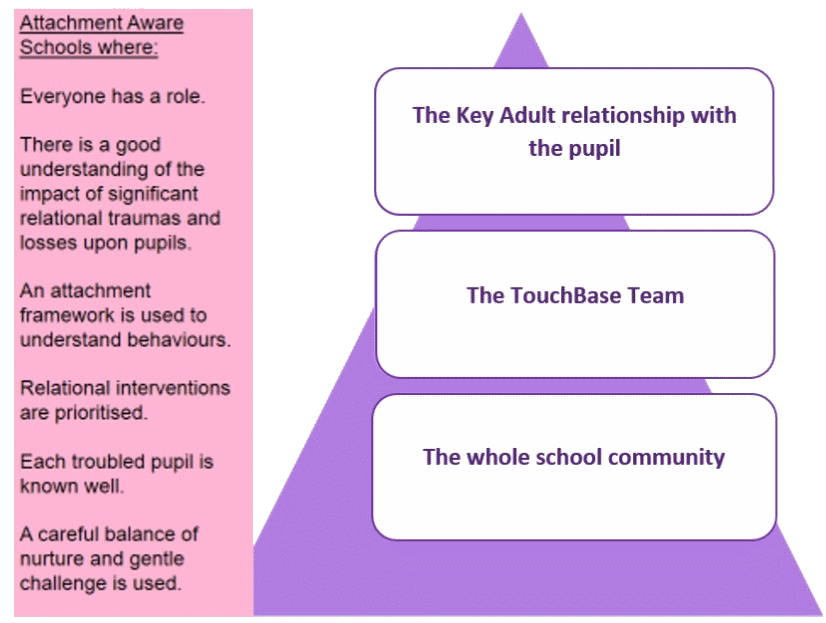
Schools can get "Attachment Aware" certified, showing their commitment to promote practitioner awareness attachment in relation to child behaviours and learning - there's a 6minute video here, and/or a flyer about attachment difficulties here.

Attachment Aware schools description


I found the site to Find my Local Attachment Lead  (attachmentleadnetwork.net) but disappointingly, I can't see any attachment aware schools in my area at the moment. The site itself does have a lot of resources for schools and details of what it is and why it is important though. 

If you are in a school, one other article I looked at that might be of interest is Attachment-aware schools (sec-ed.co.uk).

If you find any good tips or links, please feel free to add them! I know i don't need them *yet*, but it seems a pretty critical one to think about.

Later addition - Home - The Thrive Approach to social and emotional wellbeing appears to be much more widespread than the 'Attachment Aware' certification. I'll put a separate post with a bit more on that.

Comments

Popular posts from this blog

Useful information for Friends and Family

Have had some questions around this, so thought worth sharing this  https://info.adoptmatch.com/words-matter-adoption-terminology I've tried to bring together the resources I could find for friends and family. I've put the ones i think are probably top of the list starred and in bold blue to help you work out which are probably easiest/best ones to take a look at. * How family and friends can support new adopters - stepbystep (first4adoption.org.uk)  ( 2 A4 pages - above ) * 10 Things Adoptive Parents Wish Their Friends And Family Understood | HuffPost UK Parents (huffingtonpost.co.uk)  - Short article * Before I Arrive (paperback edition) by Helen Townsend | Adoption UK Charity  - excellent small book that i ended up getting a couple of copies for to share with different friends and family.  Adoption uk factsheet 12 - supporting prospective adopters with a new placement june 2013.pdf (www.nhs.uk) Ten Tips for Supporting Your Family and Friends in Adoptive F...

thanks.... it's the trauma

"What a really well behaved little one ..." is a frequent comment about my little one. Sometimes this is meant in a nice way, sometimes this is means that the speaker is feeling overwhelmed/judged for the fact their little one(s) have more typical reactions to instructions at this age. Unfortunately, this is one where nothing you say can help them to feel better. The truth is 'thanks.... it's the trauma', but that's not really the sensible thing to share. What does it look like?   - Doing what she's told  - not showing when she is angry / upset openly at the time (then reacting later/looking for me to recognise it*)  - sitting and waiting quietly when others might be jumping about  - saying "I'm sorry" when something is not their fault  - ... and more (that i'll need to add to later!) *What this means is that i find my own social battery running down much quicker than i was previously used to, because i use a lot of my energy looking for ...

little jumps

Little one is about to be 4... This means I'll be on some manic birthday planning after this. Figured I'm normally writing about the process, so today I'll share the latest for little one. She's also been going through a development jump. She's (successfully ) dressing herself without me and her writing is getting much clearer. She's exploring humour (ok, her jokes are mainly funny for the absurdity at this point).  A month ago, if you asked what she wanted to be when she grew up, the answer was 'big'. Now, she's saying a doctor or an astronaut (depending on when in you ask). A lovely vtec laptop was gifted by friends a while ago and it seemed like time to let her explore it last week... Two days later, she was typing out her own name! Considering we were initially talking about what delays there may be for her language and speech, this is an extra achievement :) She had been still going to bed with a milk bottle until recently. This had moved to wat...